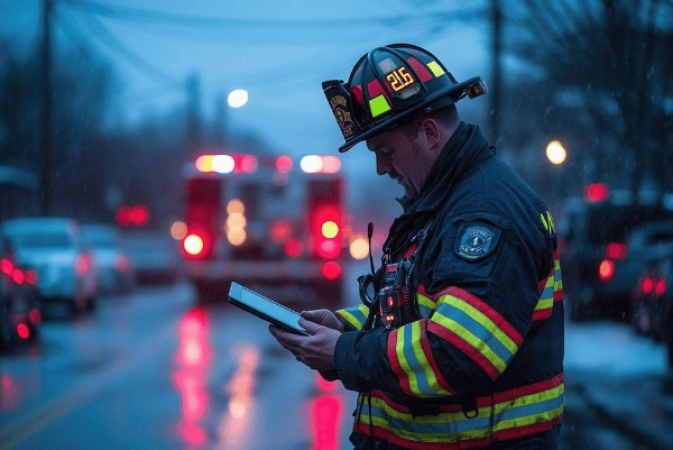
Potter Global Technologies has prioritized First Responder safety through fire suppression, mass notification, Fire Safety and Emergency Responder Communication Enhancement Systems (ERCES) for over 150 years. In the last 25 years there has been an increased effort to ensure that First Responders are not just safe when addressing emergencies inside buildings, but that they are also able to maintain reliable communication with their team. After the attack on the World Trade Center buildings in 2001, this focus became imperative, as many people lost their lives not just because of the physical damage of the attack, but also because of the FDNY’s inability to communicate while inside the building. Proper coordination and communication may have saved countless lives that day and, because of this failure, the US Department of Commerce started the search for a way to ensure First Responders would not be put into this terrible situation again. Their resolution, the development of a cellular network dedicated to First Responder communications called FirstNet.
FirstNet is a nationwide, dedicated broadband network supported by AT&T. It’s built for First Responders and delivers prioritized, resilient, and secure communications during routine operations and emergencies. It operates using AT&T’s LTE and 5G technologies along with Band 14 spectrum in the 700 MHz range (758–768 MHz uplink / 788–798 MHz downlink). While this network provides strong coverage outside buildings, it still struggles with RF building penetration because of the physical limitations of radio frequencies. Also, since Band 14 is adjacent to traditional public safety land mobile radio (LMR) frequencies (769–775 / 799–805 MHz), there is potential for interference in certain conditions, particularly in co-located or high-power RF environments. The primary medium for getting adequate signal power and quality inside buildings is an ERCES. But what do you do when your building is in an area with RF densification or if FirstNet has not been developed? You must either omit Band 14 or take great care when commissioning your ERCES.
T-Mobile and Verizon also have Public Safety focused mobile networks. T-Mobile calls their service “T-Priority” and operates on 600MHz and 2.5GHz frequencies, keeping interference to a minimum as it is far enough away from the 700MHz and 800MHz Public Safety allotments. Verizon calls theirs “Verizon Frontline” and operates on 700MHz Band 13 and 3.5GHz C-Band frequencies. These frequencies are also far enough away from the Public Safety allotments that interference is minimal. Along with FirstNet, these carrier offerings do require specifically calibrated and configured smartphones, tablets and radios to operate properly. Just like a cellphone that shows “5G” in the top corner, unless the service is available in the area and has been purchased and installed through a configured sim-card, the network will not be operating on the device.
One way you can work around FirstNet is with the use of the proper class of Bi-directional Amplifiers, or BDAs. BDAs are broken up into two classes: Broadband Class B and Channelized Class A. The GuardianA is a channelized BDA and does not support the FirstNet frequencies so it can be used in dense RF environments. The GuardianB is a broadband BDA that does support FirstNet, but if it is commissioned in a dense cellular LTE environment, there may be issues with interference in Band 14. In the case where Class B BDAs are required by the Authority Having Jurisdiction, you may need to use something called a “notch filter”. This ancillary component is installed inline on the donor antenna line going into the BDA and filters out specific frequencies, in this case, Band 14. This prevents the BDA from receiving and/or transmitting any of the frequencies blocked by the notch filter, preventing any interference with cellular LTE networks in the area.
Knowledge is power when it comes to ERCES and knowing what networks your First Responders are using in your jurisdiction is paramount, especially if your AHJ is requiring you to enhance LTE networks inside the building. Not only do you need to consider what frequency you are enhancing, you also need to consider what cellular networks your ERCES might be affecting, and conversely, what networks may be affecting your ERCES. It’s a lot to consider, but careful consideration will increase your chances of a properly tuned system that guarantees your First Responders are able to communicate throughout your building, keeping them safe and preventing tragedy in even the most perilous circumstances.